If the Moon Were Only 1 Pixel - A Model of the Solar System


Artist and designer Josh Worth wrote on his blog:

"I was talking about the planets with my 5-year-old daughter the other day. I was trying to explain how taking a summer vacation to Mars in the future will be a much bigger undertaking than a trip to Palm Springs (though equally as hot). I kept trying to describe the distance using metaphors like “if the earth was the size of a golf ball, then Mars would be across the soccer field” etc., but I realized I didn’t really know much about these distances, besides the fact that they were really large and hard to understand. Pictures in books, planetarium models, even telescopes are pretty misleading when it comes to judging just how big the universe can be. Are we doing ourselves a disservice by ignoring all the emptiness?

So I thought I would see if a computer screen could help make a map of a solar system that’s a bit more accurate (while teaching myself a few things about javascript, SVGs and viewports along the way). Not that pixels are any better at representing scale than golfballs, but they’re our main way of interpreting most information these days, so why not the solar system?"

Click here to visit some of the big spaces out in space and be prepared to scroll!

How To Moonwalk


It’s never too late to learn a proper moonwalk! Most people do it exactly the wrong way. But not you. Not anymore. Thanks to Jacob O'Neal at Animagraffs.

Learn to moonwalk the right way!

The Hitchhiker's Guide to the Galaxy Game - 30th Anniversary Edition


The BBC has released a new version of The Hitchhiker's Guide to the Galaxy text-based adventure game to celebrate its 30th anniversary.

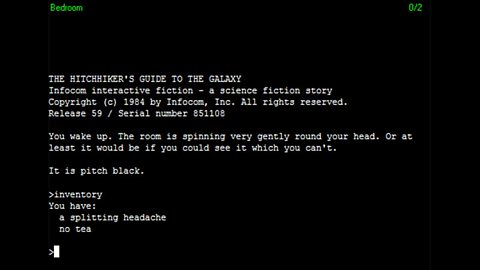
The original Infocom Game released in 1984
"There was a time when computer games didn't have graphics. Or at least they couldn't have graphics and sound at the same time. They certainly couldn't have graphics, sound and enough content to keep even a human being amused for more than a few minutes. The original game launched in 1984 was a text game where you type instructions and the game responds with a description of your surroundings and what has happened as a result of your last action.

The Hitchhiker's Guide to the Galaxy Game - 20th anniversary edition
The 20th anniversary edition was still essentially a text game. The Infocom origins of the game were still evident, from the opening credits to the 'Help' message.  It was not an attempt to produce a fully animated version, the graphics as followed in the tradition of E. H. Shepard's illustrations for A.A. Milne's books - they didn't reflect all the events described. Most of the images rightly remained, to quote Simon Jones, "in the universe of your head."

The Hitchhiker's Guide to the Galaxy Game - 30th anniversary edition
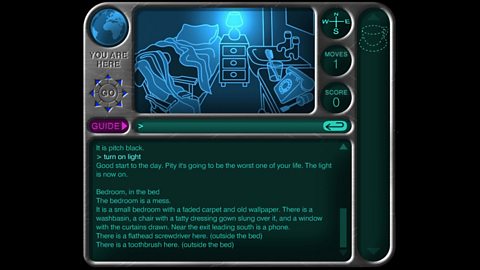
The 30th Anniversary Edition game is still the same wonderful piece of interactive fiction that Douglas Adams wrote and Steve Meretzky programmed, but in finding it a new home, a few changes needed to be made. The old Flash game would not work on the new servers, and in porting it to a new HTML5 incarnation, several innovations took place. We were able to build in a larger, handier interface, with additional keys and functionality, and build in the ability to tweet from the game. The game remains essentially unchanged and the original writing by Douglas Adams remains untouched. It is still played by entering commands and pressing return. Then read the text, follow your judgement and you will probably be killed an inordiate number of times."

(Source for about the game)


Play The Hitchhiker's Guide to the Galaxy Game

bot or not

This website is a Turing test for poetry. You, the judge, have to guess whether the poem you’re reading is written by a human or by a computer.

 If you think a poem was written by a computer, choose 'bot'. If you think it was written by a human, choose 'not'.

What is a Turing test? In 1950, Alan Turing devised the Turing test as a way of verifying machine intelligence. The Turing test is a proposed a situation in which a human judge talks to both a computer and a human through a computer terminal. The judge cannot see the computer or the human, but can ask them questions via the computer. Based on the answers alone, the human judge has to determine which is which.

View Bot or Not

Getty Images opening up much of its photo stock for free use

Internet users will be able to tweet, blog, or otherwise post photos with Getty’s embed feature that attaches a credit and link to each image. Anyone can now visit the Getty website, grab some embed code, and display an image on blogs (As I have done here.) without paying a licensing fee. The code is the same iFrame code that you use to embed YouTube videos, maps, photos, and tweets.

The image below shows the embed link to use when looking at a photo you wish to use.


Below is the photo embeded into this blog post using the iFrame code.


View Getty Images

7 Reasons Why You Will Never Do Anything Amazing With Your Life

7 Reasons Why You Will Never Do Anything Amazing With Your Life shows "a unique perspective on what it takes to succeed". It's a reality check at the kind of skills you'll really need if you want to do something great, and explains why you probably don't have those skills (even if you think you do). View Source

African Fractals


A fractal is a pattern that repeats itself at different scales. It is ideal for modeling nature: a tree is a branch of a branch of a branch; mountains are peaks within peaks; clouds are puffs of puffs, and so on. But modern computer scientists aren't the only ones to use fractals: Africans have been using them for centuries to design textiles, sculptures, architecture, hairstyles and more. In this website you will learn how fractal geometry is used in computing and science, and apply that knowledge to simulating African designs.

View Source

Immersion: a people-centric view of your email life


"It has been almost two decades since the beginning of the web. This means that the web is no longer just a technology of the present, but also, a record of our past.

Email, one of the original forms of social media, is even older than the web and contains a detailed description of our personal and professional history.

Immersion is an invitation to dive into the history of your email life in a platform that offers you the safety of knowing that you can always delete your data. Just like a cubist painting, Immersion presents users with a number of different perspectives of their email data. It provides a tool for self-reflection at a time where the zeitgeist is one of self-promotion. It provides an artistic representation that exists only in the presence of the visitor. It helps explore privacy by showing users data that they have already shared with others. Finally, it presents users wanting to be more strategic with their professional interactions, with a map to plan more effectively who they connect with."

Need a Name?

If you need to generate names for use in designs and mockups, uinames.com is just the site. It's well-designed, with an incredibly easy to use interface. Just press the spacebar for a new name to be generated. You can choose whether you want male or female names, but other than that, it's a no-frills tool that does exactly what it's meant to do.

Camper Obscura


After more than a year of planning, the Summer of 2010 saw FOTONOW bring their project Camper Obscura into life. Photographers Jonathan Blyth and Matthew Pontin had already established a practice in working with communities in building camera obscuras in working with young people on education projects, the idea of a mobile vehicle emerged in the shape of a Foster and Day coach-built 1986 VW T25 camper van. The UK photographers have taken their lesson to the streets - literally - by converting the camper van into an enormous camera on wheels that they call Camper Obscura


Google Street View World


Google™ Street View refers to panoramic 360° images taken by a special camera mounted on various types of vehicles. These images are view-able via Google Maps™, Google Earth™ and custom applications and websites developed using the Google™ Street View Image API. Google Street View started capturing images a way back in 2007. Since then, Google™ Street View has captured images from over 56 countries and hundreds of attractions ranging from walking trails to theme parks, museums to zoos, and everything in between.

Google™ Street View World endeavors to capture some of the more “interesting”, funny, and crazy situations passed by via the Google™ Street View project.

 View Source

I'm Just Walkin'


In 2010, Matt Green, walked across the United States from Rockaway Beach, Queens, to Rockaway Beach, Ore. The journey took five months, during which he averaged 20 miles a day. Now he's doing a new walk. He's walking every street in New York City. "This is the counterpoint to my walk across the US. Instead of seeing a million places for just a minute each, I'm going to spend a million minutes exploring just one place. By the time I finish walking every block of every street in all five boroughs, I'll have traveled about 8000 miles on foot — all within a single city."

View Just Walkin'

d*face Spraypaint Skateboarding at Ridiculous


In a project by london-based artist d*face at the Southern California skate pool 'ridiculous', skateboarders become the human brushes on the concrete canvas of the pool's walls, leaving permanent colourful skatetrails as they ride.


See skateboarders become human paintbrushes.t

The Amazing Fact Generator


Here's an example of the type of 'facts' you'll find on this site brought to you by mental_floss!:

"Francis Galton, the inventor of fingerprinting, had many other notable ideas: the weather map, the phrase “nature vs. nurture,” and the silent dog whistle."

View The Amazing Fact Generator