10 Minute Mail - Temporary E-Mail


10MinuteMail is a secure temporary e-mail service. This means that it lets you have a private e-mail address that anyone can send e-mail to. The e-mail and the address both self-destruct in 10 minutes, so you don't have to worry about SPAM or anything like that.


Why would I use 10MinuteMail?

The most common reason to use a temporary e-mail service like 10MinuteMail is if you are forced to give an e-mail address to a website you don't fully trust. Many websites force you to register in order to see content. Many of those websites will then either send you SPAM for years or, even worse, sell your e-mail address to large scale SPAM operations. 10MinuteMail allows you to easily give an e-mail address that won't exist in 10 minutes, so there's no risk of SPAM. If the website makes you verify the e-mail address by sending you a link to your e-mail that you have to click, then you can read the e-mail right here on www.10minutemail.com and click on the link. You can also reply to e-mail, as some sites require a reply. You can forward the e-mail to your personal account if there's some information you need to save. 

How do I use 10MinuteMail?

  • When you need an e-mail address to fill out an online form or registration, just open another window or tab and go to 10MinuteMail.com.
  • The e-mail address you see on the page is yours. You are the only person who can see that address.
  • You can copy it from the window, or just click on the icon that looks like two sheets of paper which will automatically copy the e-mail address to your clipboard. DO NOT CLOSE the 10MinuteMail.com window.
  • Then paste the e-mail address into the website you needed it for, complete the registration/form/whatever.
  • If the site sends you an e-mail, it should show up on the 10MinuteMail.com page, down on the page, under the Messages section. It may take a couple of minutes to arrive.
  • Once you see it there, just click on it, and you can read the e-mail. Then you can click on any links, or get any information you need.
  • When you are done, just close the 10MinuteMail.com window, or wait for the 10 minutes to expire. That's it.
View Source

Email Design Guide


MailChimp's Email Design Guide is filled with tips and advice to help you convey your message in style. Learn how to better use images, fonts, calls to action and more. It's all laid out in an easy to understand format, fully illustrated and broken into sections for content, templates, identity, color, images, layout, fonts, and CTAs.


View MailChimp's Email Design Guide

A Bear's-Eye View of Yellowstone


"For the first time, trek into the wild backcountry of America's first national park and see what it looks like from a bear's point of view."

"Special cameras were attached to the tracking collars of two grizzlies and two black bears in Yellowstone. Massive and hungry, these bears prowl for food and confront danger along the way. It's a matter of life and death for all of them. Tag along as National Geographic gives you an unprecedented window into some of the most fearsome predators on Earth. And watch as these bears act as tour guides through their secret world, with little human intervention."

View National Geographic video

Data USA Attempts to Make Government Data Understandable


Data USA, a project by the M.I.T. Media Lab and Deloitte, is free to use. According to their site:

"Data USA puts public US Government data in your hands. Instead of searching through multiple data sources that are often incomplete and difficult to access, you can simply point to Data USA to answer your questions. Data USA provides an open, easy-to-use platform that turns data into knowledge. It allows millions of people to conduct their own analyses and create their own stories about America – its people, places, industries, skill sets and educational institutions. Ultimately, accelerating society’s ability to learn and better understand itself."
Visit Data USA

Animated Iconic Paintings

Revived Artworks is the latest project from Feel Desain. Inspired by the world’s current love of all things animated, they've brought some of the most famous portraits from history to life, like The Girl With The Pearl Earring, Andy Warhol’s Marilyn Monroe and Edvard Munch’s The Scream. Taking these iconic images, they put some expression back into the subjects faces, and now they can look at you right out of your screen. The collection is comprised of 9 images, and they’ll be adding others soon.

View Source

Stuff in Space


Stuff in Space is a realtime 3D map of objects in Earth orbit, visualized using WebGL.

The website updates daily with orbit data from Space-Track.org and uses the excellent satellite.js Javascript library to calculate satellite positions.

The creator of this site is James Yoder; He's an alumnus of FIRST Robotics Competition (FRC) Team 624 and an incoming Electrical and Computer Engineering freshman at the University of Texas at Austin.

Visit this site. 

Sincerity Machine: The Comic Sans typewriter


"Sincerity Machine: The Comic Sans typewriter was made after viewing a document with a typewriter font present in it; Jesse England realized there was nothing stopping him from altering a typewriter to write in a different font. He used a laser engraving machine to etch new letters out of acrylic, and glued them onto the strikers of a 70's era, Sears-branded Brother Charger 11 typewriter, which he found in the street a couple years ago. He also used a vinyl cutter to make new key covers as well."

Watch a video of the typewriter.

Paper Art: Principle of Design Poster Series


"Turkish graphic designer Efil Türk has created series of paper art posters for her Thesis project called: Principle of Design Poster Series - featuring top 10 design principles; Balance, Hierarchy, Pattern, Rhythm, Space, Proportion, Emphasis, Movement, Contrast, and Unity with their own paper art form."

 View Source - Joquz.com

The Elements of Design


In just 50 seconds this animated video will illustrate the standard elements of design. These traditional elements of design are taught in design programs and if you know nothing about design and these elements then spend 50 seconds to learn something today.

View the video on Vimeo

Smarty Pins


Do you like maps, love trivia, and you know where most cities are on the map, then you're going to love Google's new SmartyPins game. This map-trivia game runs on the Google Maps platform and allows you to spend 1,000 miles trying to mark the correct location to each question asked.

The Internet in Real-Time


Click the animation to open the full version (via PennyStocksLab).

The Internet in Real-Time looks at a number of websites and services, including app downloads from Apple and Google, You Tube videos watched, items purchased on Amazon, tweets sent, hours viewed on Netflix, and so much more.

Make Your Own Grid Paper


At Gridzzly.com you can create printable grid paper. You begin by choosing from a variety of styles, including dot grids and line grids. Once you've made your choice choose your grid size by using a slider. When everything is to your liking click on the "Print" button to print out your creation.

Make your own grid paper!

Cognitive Lode - Brain gems for decision-makers


Cognitive Lode is a free resource by ribot to help you make better products. They distill the latest behavioural economics and consumer psychology research down into helpful little brain gems. You start by reading the summaries on the home page and should you want to know more you click on the link to read the long descriptions. As example here is a typical summary:

"The Cognitive Miser. We’re intellectually lazy, avoiding hard questions where possible. A bat and ball together cost $1.10. The bat costs $1 more than the ball. How much does ball cost? Intuition says 10¢, but it’s not. The answer’s in the long description…"

Or this one:

"Hedonic Adaptation. Restricting pleasure increases pleasure. Enjoyment of a television program is actually enhanced by commercial interruptions, despite what viewers say."

These bits of advice would seem to valuable for decision-makers, while the rest of us will enjoy how we are often manipulated by companies without us even knowing.

 View the Cognitive Lode

A 50-cent microscope that folds like origami


"Perhaps you’ve punched out a paper doll or folded an origami swan? TED Fellow Manu Prakash and his team have created a microscope made of paper that's just as easy to fold and use. A sparkling demo that shows how this invention could revolutionize healthcare in developing countries … and turn almost anything into a fun, hands-on science experiment."

Watch this TED Talk below:


  View Source

Origins of Common User Interface Symbols


"They are road signs for your daily rituals — the instantly recognized symbols and icons you press, click and ogle countless times a day when you interact with your computer. But how much do you know about their origins?"

View the Origins of User Interface Symbols

If the Moon Were Only 1 Pixel - A Model of the Solar System


Artist and designer Josh Worth wrote on his blog:

"I was talking about the planets with my 5-year-old daughter the other day. I was trying to explain how taking a summer vacation to Mars in the future will be a much bigger undertaking than a trip to Palm Springs (though equally as hot). I kept trying to describe the distance using metaphors like “if the earth was the size of a golf ball, then Mars would be across the soccer field” etc., but I realized I didn’t really know much about these distances, besides the fact that they were really large and hard to understand. Pictures in books, planetarium models, even telescopes are pretty misleading when it comes to judging just how big the universe can be. Are we doing ourselves a disservice by ignoring all the emptiness?

So I thought I would see if a computer screen could help make a map of a solar system that’s a bit more accurate (while teaching myself a few things about javascript, SVGs and viewports along the way). Not that pixels are any better at representing scale than golfballs, but they’re our main way of interpreting most information these days, so why not the solar system?"

Click here to visit some of the big spaces out in space and be prepared to scroll!

How To Moonwalk


It’s never too late to learn a proper moonwalk! Most people do it exactly the wrong way. But not you. Not anymore. Thanks to Jacob O'Neal at Animagraffs.

Learn to moonwalk the right way!

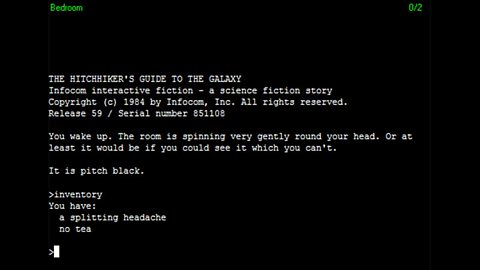
The Hitchhiker's Guide to the Galaxy Game - 30th Anniversary Edition


The BBC has released a new version of The Hitchhiker's Guide to the Galaxy text-based adventure game to celebrate its 30th anniversary.

The original Infocom Game released in 1984
"There was a time when computer games didn't have graphics. Or at least they couldn't have graphics and sound at the same time. They certainly couldn't have graphics, sound and enough content to keep even a human being amused for more than a few minutes. The original game launched in 1984 was a text game where you type instructions and the game responds with a description of your surroundings and what has happened as a result of your last action.

The Hitchhiker's Guide to the Galaxy Game - 20th anniversary edition
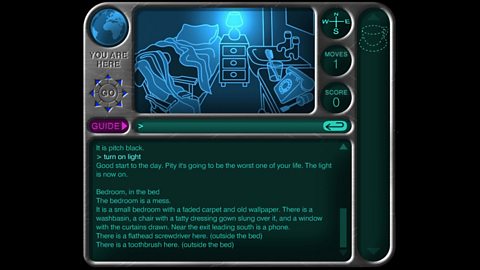
The 20th anniversary edition was still essentially a text game. The Infocom origins of the game were still evident, from the opening credits to the 'Help' message.  It was not an attempt to produce a fully animated version, the graphics as followed in the tradition of E. H. Shepard's illustrations for A.A. Milne's books - they didn't reflect all the events described. Most of the images rightly remained, to quote Simon Jones, "in the universe of your head."

The Hitchhiker's Guide to the Galaxy Game - 30th anniversary edition
The 30th Anniversary Edition game is still the same wonderful piece of interactive fiction that Douglas Adams wrote and Steve Meretzky programmed, but in finding it a new home, a few changes needed to be made. The old Flash game would not work on the new servers, and in porting it to a new HTML5 incarnation, several innovations took place. We were able to build in a larger, handier interface, with additional keys and functionality, and build in the ability to tweet from the game. The game remains essentially unchanged and the original writing by Douglas Adams remains untouched. It is still played by entering commands and pressing return. Then read the text, follow your judgement and you will probably be killed an inordiate number of times."

(Source for about the game)


Play The Hitchhiker's Guide to the Galaxy Game

bot or not

This website is a Turing test for poetry. You, the judge, have to guess whether the poem you’re reading is written by a human or by a computer.

 If you think a poem was written by a computer, choose 'bot'. If you think it was written by a human, choose 'not'.

What is a Turing test? In 1950, Alan Turing devised the Turing test as a way of verifying machine intelligence. The Turing test is a proposed a situation in which a human judge talks to both a computer and a human through a computer terminal. The judge cannot see the computer or the human, but can ask them questions via the computer. Based on the answers alone, the human judge has to determine which is which.

View Bot or Not

Getty Images opening up much of its photo stock for free use

Internet users will be able to tweet, blog, or otherwise post photos with Getty’s embed feature that attaches a credit and link to each image. Anyone can now visit the Getty website, grab some embed code, and display an image on blogs (As I have done here.) without paying a licensing fee. The code is the same iFrame code that you use to embed YouTube videos, maps, photos, and tweets.

The image below shows the embed link to use when looking at a photo you wish to use.


Below is the photo embeded into this blog post using the iFrame code.


View Getty Images